 The Project Desk
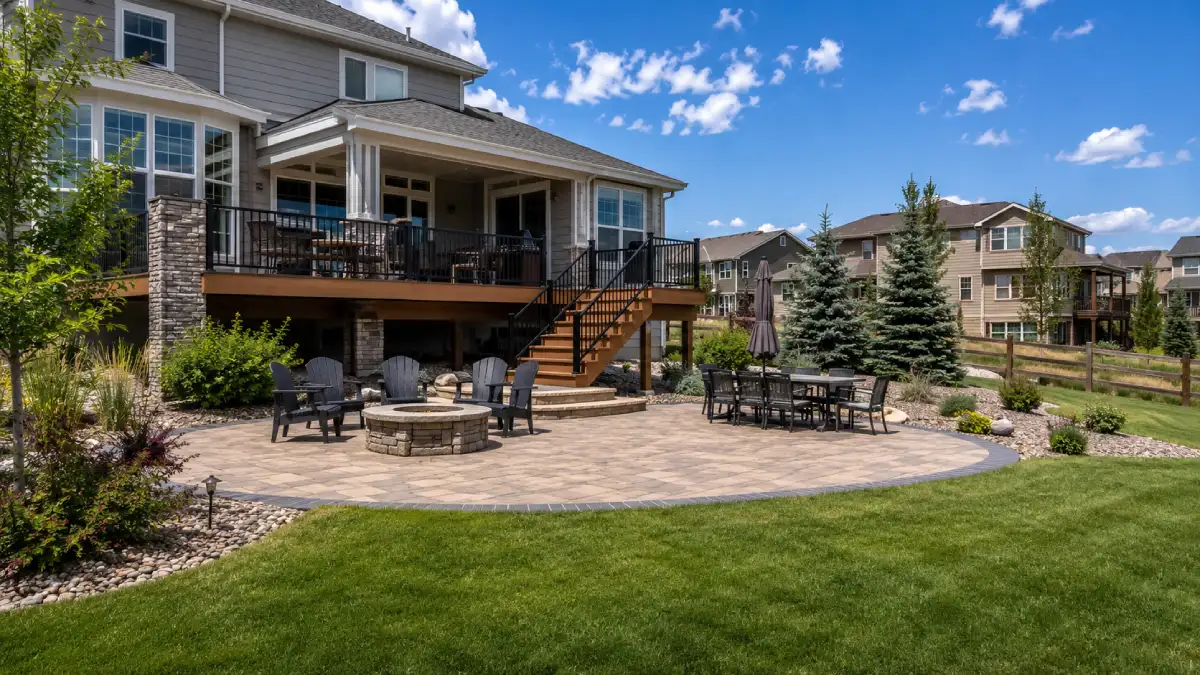
Ask five neighbors whether you should build a deck or a patio and you’ll get five confident answers, usually based on whatever they happen to own. The honest answer is that decks and patios solve different problems — and in Colorado, a few local factors change the math in ways that surprise people who moved here from somewhere flatter, wetter, or closer to sea level.
Here’s how to actually think through the decision.
Start with your yard, not the catalog
The single biggest factor isn’t style or even budget. It’s what your lot gives you to work with.
If your back door sits well above grade — common in Front Range two-stories and anything with a walkout basement — a deck is usually the natural answer. Building a patio at ground level below a door that’s four feet up means adding stairs, retaining, and regrading, and you end up spending deck money anyway to solve a problem a deck solves by default.
If your yard is flat and the door is at or near grade, a patio becomes very attractive. You’re building on the ground instead of above it, which generally means less structure, less maintenance, and often less cost per square foot.
If your yard slopes, it depends which way and how much. Decks handle slopes gracefully because they stand on piers. Patios on slopes need cut-and-fill work and usually retaining walls, and retaining walls are where patio budgets quietly double.
The Colorado complications
This is the part most national cost guides skip, and it matters here more than almost anywhere.
Expansive clay soil
Much of the Front Range — Denver, the south metro, big stretches of Aurora and the western suburbs — sits on expansive clay. This soil swells when it gets wet and shrinks when it dries, and it moves whatever’s sitting on it. A concrete patio poured on poorly prepped clay can heave, crack, and tilt within a few seasons. Anyone who’s watched a garage slab crack in Highlands Ranch knows exactly what this looks like.
That doesn’t mean you can’t build a patio on clay. It means site prep matters enormously: proper excavation, compacted base material, and drainage that moves water away from the slab. Pavers handle clay movement better than a monolithic concrete pour, because individual pavers can be lifted and releveled if things shift. Stamped concrete looks great on day one, but a crack through a stamped pattern is hard to repair invisibly.
Decks mostly sidestep the issue, since they bear on caissons or piers that go below the active soil layer. Your contractor should still know local soil conditions when sizing footings — jurisdictions along the Front Range have specific requirements for exactly this reason.
Freeze-thaw cycles
Colorado doesn’t just get cold — it swings. A February afternoon can hit 60 degrees and drop below freezing by night. Water gets into small cracks, freezes, expands, and pries the crack wider. Over years, this is what spalls concrete surfaces and works pavers loose.
The practical takeaways: concrete work needs the right mix and proper control joints, pavers need a well-drained base, and wood decks need sealing on a real schedule. None of this is exotic — it’s standard practice for good local contractors — but it’s a real difference between a builder who works here and one following a national playbook.
Sun at altitude
UV exposure at 5,000+ feet is brutal on wood. An unsealed cedar deck that might quietly gray over a decade at sea level will dry, crack, and splinter noticeably faster here. That’s a big part of why composite decking has taken over so much of the Colorado market despite costing more upfront — the maintenance math tilts in its favor when the sun is this strong. If you love real wood, plan on cleaning and resealing every couple of years, and mean it.
South- and west-facing installations also get hot. Some composite boards get genuinely uncomfortable barefoot in July. Lighter colors help, and so does a pergola or shade structure — which many homeowners end up adding later anyway.
Hail
If you’re considering a roof over any part of the space — a covered patio, a pergola with polycarbonate panels — remember you’re in one of the most hail-prone corridors in the country. Material choice on overhead structures matters here in ways it doesn’t in most states.
What things actually cost in 2026
Ranges below reflect what we’re seeing across the Front Range for professionally built projects. Small jobs, difficult access, and premium materials push these numbers up.
| Option | Typical installed cost | Notes |
|---|---|---|
| Pressure-treated wood deck | $40–$60 per sq ft | Lowest entry cost, highest maintenance |
| Cedar deck | $50–$75 per sq ft | Beautiful, but plan for regular sealing |
| Composite deck | $60–$100+ per sq ft | Most popular choice here; minimal upkeep |
| Stamped concrete patio | $18–$30 per sq ft | Good value; cracks are hard to hide |
| Paver patio | $25–$50 per sq ft | Repairable, handles clay movement best |
| Flagstone patio | $30–$55+ per sq ft | Premium look, labor-intensive |
A few things worth noticing in that table. A basic patio costs roughly half of a comparable deck, which is why “patio plus nice furniture” is often the budget-friendly answer for flat yards. And the gap between wood and composite decking narrows a lot once you price in fifteen years of staining and board replacement.
Retaining walls, outdoor kitchens, fire features, and lighting are all add-ons that can matter more to the final number than the deck-versus-patio choice itself. It’s common for a “patio project” along the Front Range to end up being 40% patio and 60% everything around it.
Permits: yes, this applies to you
In most Colorado jurisdictions, a deck more than 30 inches above grade requires a building permit, and attached decks usually trigger one regardless. Patios at grade typically don’t need a permit by themselves — but add a roof, a gas line for a fire pit or grill, or electrical for lighting, and you’re pulling permits for those.
Two more local wrinkles. First, if you’re in an HOA — and a huge share of south metro and newer Front Range neighborhoods are — you’ll likely need design review approval before anyone digs, and that can add weeks. Second, jurisdictions vary a lot: what Jefferson County wants to see is not identical to what Denver or Douglas County wants. A contractor who regularly works in your specific city or county will know, and it’s a fair question to ask them directly.
Whatever you do, don’t let anyone talk you into skipping a required permit. Unpermitted structures surface at resale, and the fix at that point is expensive and miserable.
The honest decision framework
If you strip it down, the choice usually resolves like this:
Choose a deck when your door sits above grade, your lot slopes, you have a walkout basement, or you want the elevated view. You’ll pay more per square foot and sign up for some maintenance (much less with composite), but you’re buying the option that fits your architecture.
Choose a patio when your yard is flat, you want the most space for the money, or you’re picturing things that live better on the ground anyway — fire pits, outdoor kitchens, hot tubs (which need serious structural reinforcement on a deck, but just sit on a patio).
Choose both when the budget allows, honestly. Some of the best outdoor spaces we see along the Front Range are a modest deck at the door stepping down to a larger patio — the deck handles the transition from the house, the patio handles the living. It’s not an either/or question nearly as often as people assume.
One last thing about timing
Everyone calls outdoor contractors in April. If you can plan your project in fall or winter, you’ll typically get more responsive scheduling, more design attention, and sometimes better pricing — and you’ll be first on the calendar when the ground thaws instead of joining the spring waitlist. The best time to plan a summer patio is when there’s snow on the ground.
When you’re ready to get real numbers for your yard, The Project Desk can match you with vetted local Colorado pros — you choose whether to meet one or compare a few, and we line up the appointment for you.
![How Much Does It Cost to Finish a Basement in Colorado? [2026 Guide]](/images/articles/basement-finishing-cost.webp)